
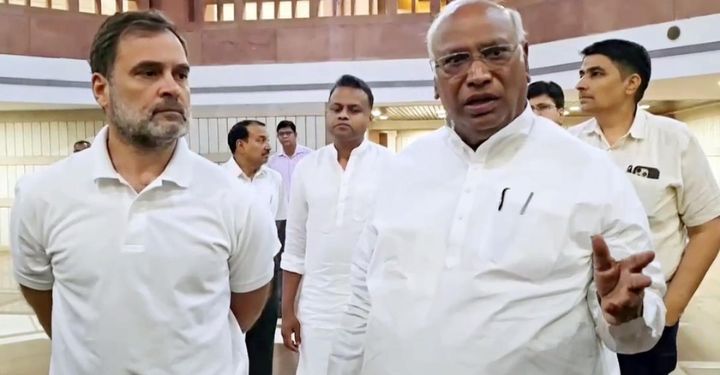
The chilling terror attack in Pahalgam has triggered a nationwide outcry, with political leaders, civil society, and international observers urging India to take decisive action. Leading the opposition’s charge, Congress President Mallikarjun Kharge has called for a special session of Parliament, asserting that a united political front is needed to counter terrorism both domestically and internationally.
On April 22, five armed militants opened fire on unarmed civilians in the Baisaran Valley of Anantnag district. The attack, executed with brutal precision, killed 26 and injured over 30. Several survivors have recounted that the attackers singled out individuals based on religion—a chilling detail that has reignited fears of a renewed attempt to destabilize Kashmir’s social fabric.
A National Security Inflection Point
Kharge described the attack as “a moment that demands not just condemnation, but clarity and coordination.” In his formal statement to Prime Minister Narendra Modi, Kharge wrote, “This tragedy cannot be brushed aside as a routine terror incident. We must meet it with a national security reset, and that requires the Parliament to come together.”
He emphasized the need for:
- Reassessment of the current counterterrorism framework
- Increased intelligence cooperation among central and state agencies
- Expanded funding for civilian protection and mental health aid in conflict zones
- Investigation into possible lapses by security and intelligence agencies
Government Response and Resistance
The Modi government has condemned the attack unequivocally. However, BJP leaders have so far resisted the idea of a special Parliament session. Sources in the Ministry of Parliamentary Affairs indicated that the upcoming monsoon session may touch on security issues, but no separate session is being considered at present.
Minister of State for Home Affairs Nityanand Rai, speaking to media, said, “We respect the opposition’s concerns, but security forces are doing their job. We will give a statement in Parliament at the appropriate time.”
This response has not satisfied the opposition. “Why wait?” asked Kharge. “The country needs leadership now. This is not the time to be bureaucratic. It’s the time to unite and legislate.”
Political Unity: A Strategic Tool Against Terror
Kharge’s call is based not just on national solidarity but also on international optics. “When the world sees India’s Parliament united in condemning terrorism, it sends a message far louder than any military action,” he said.
Foreign leaders including France’s Emmanuel Macron and US President Joe Biden have condemned the attack and expressed support for India. Observers believe a formal, bipartisan parliamentary resolution could reinforce India’s diplomatic efforts to pressure nations that support terrorism covertly.
Kashmir’s Civilian Wounds
The Pahalgam attack has reopened wounds in a region that has struggled for years to balance fear, hope, and normalcy. Several survivors and families of victims have urged the government to prioritize not just security, but justice and economic rehabilitation.
“We lost our father. Who will take care of our family now?” said Aasma Bhat, the daughter of a cab driver killed in the attack. “We want peace and protection. No more statements—only action.”
What Happens Next?
While political maneuvering continues in Delhi, security operations have been intensified in south Kashmir. Drones, checkpoints, and military convoys have returned in full force to areas that were slowly beginning to resemble pre-conflict times.
Kharge remains firm that a special session is the most democratic and transparent path forward. “Let every party be heard. Let the nation see we are serious. If not now, then when?”
For More News updates : https://asiapedia.in