
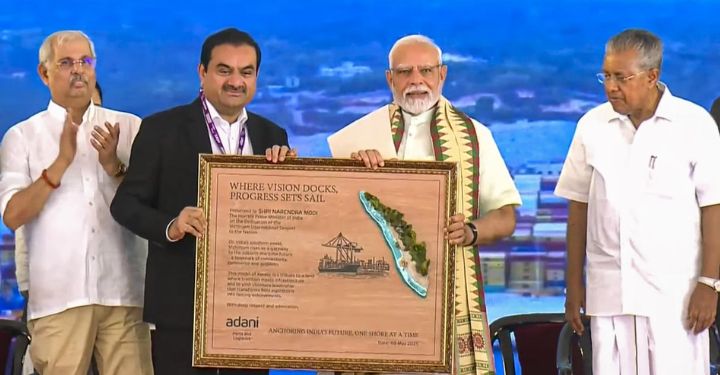
Amravati, the once-stalled dream capital of Andhra Pradesh, is now roaring back to life, thanks to a renewed push from the central government and a strategic visit by Prime Minister Narendra Modi. On May 2, 2025, Modi’s presence in the heart of the state’s capital region marked more than a ceremonial visit—it reestablished Amravati’s critical role in India’s federal framework and injected momentum into one of India’s most ambitious urban projects.
Once envisioned as a world-class smart city following the bifurcation of Andhra Pradesh and Telangana in 2014, Amravati had since suffered a period of stagnation, policy reversals, and halted projects. However, recent political alignment and renewed focus have created a perfect storm for revival.
The Prime Minister’s Mission
PM Modi’s arrival in Amravati wasn’t just accompanied by security cordons and ceremonial fanfare—it came with action. The Prime Minister launched and laid the foundation for infrastructure and development projects worth ₹58,000 crore. These initiatives aim to transform Amravati into a self-sufficient, sustainable, and technologically integrated capital city.
In his speech to a crowd of government officials, local citizens, and land donors, Modi reiterated the Centre’s long-term vision. “Amravati is not just about concrete and steel. It is about spirit, culture, progress, and future,” he said, asserting that the government would ensure full compliance with the promises made under the Andhra Pradesh Reorganisation Act.
What’s Being Built?
The ₹58,000 crore worth of projects include:
- A modern legislative assembly complex
- An integrated administrative hub
- Educational and research institutions
- A super-specialty hospital
- High-speed roadways and urban transit solutions
- Green zones, parks, and pedestrian-friendly infrastructure
The Prime Minister also announced support for a new metro rail corridor connecting the capital to Vijayawada and Guntur, further integrating the region and reducing commute time for lakhs of daily travelers.
Revisiting a Vision Deferred
Back in 2015, Amravati was introduced to the world with ambitious plans and a foundation stone laid in the presence of international dignitaries. Singapore-based consultants developed a high-concept master plan that promised wide boulevards, state-of-the-art public buildings, and seamless integration of technology into everyday life.
However, political shifts in the state administration in 2019 led to a re-evaluation of the capital strategy. The subsequent government proposed a three-capital model—dividing legislative, executive, and judicial functions among different cities. This created uncertainty, halted progress, and discouraged investors.
Now, under Chief Minister N. Chandrababu Naidu’s leadership once again, the single-capital model centered around Amravati is back. Naidu, standing shoulder-to-shoulder with the Prime Minister, declared: “The city will no longer remain a vision—it will be a functioning reality within five years.”
The Economic Stakes
The economic implications of developing Amravati are vast. The project is expected to boost the local economy, create over 2 lakh direct and indirect jobs, and drive ancillary industries such as real estate, manufacturing, and IT services. With connectivity to major national corridors and strategic positioning between coastal ports and industrial centers, Amravati is poised to be a growth catalyst for the region.
Additionally, foreign investors, particularly from Japan and Singapore, are once again showing interest as policy clarity returns. “Investor confidence is being rebuilt day by day,” said a state government spokesperson.
People at the Center
At the heart of this project are the people—especially the thousands of farmers who contributed their land to the initial land pooling scheme. Their aspirations had remained in limbo for years. With construction resuming and master plans being revised for updated zoning and utility access, many of them now express cautious optimism.
Suresh Kamma, a farmer-turned-entrepreneur, said: “When we gave our land, it was with hope. For years, we saw nothing. Today, seeing PM Modi and Naidu together tells us that our land will finally become something great.”
Environmental Responsibility
With the Krishna River flowing nearby and fertile farmland surrounding the region, environmental concerns remain significant. The revised Amravati plan now includes strict sustainability targets—20% of all energy used in public buildings will come from renewable sources, and over 30% of land is earmarked for green spaces. A detailed environmental impact audit will be conducted every six months by an independent panel to ensure compliance.
Beyond Infrastructure: A Symbol of Federal Unity
PM Modi’s gesture of bringing sacred soil and Yamuna water from New Delhi to be ceremonially mixed into the Amravati foundation may seem symbolic, but it represents deeper intent. It signifies the unity between the Centre and states, the bridging of North and South India, and the shared responsibilities in India’s democratic structure.
“Today, Amravati is not just Andhra’s capital—it’s India’s capital of aspiration,” said Union Home Minister Amit Shah in a press release later that day.
Challenges Ahead
Despite the optimism, challenges remain. Legal cases regarding land rights, pending infrastructure clearances, funding gaps, and the necessity for continual state-central coordination are hurdles that must be overcome. However, experts agree that with bipartisan political will and robust monitoring, the project can finally achieve lift-off.
Urban planning expert Prof. Reena D’Souza from IISc Bangalore noted, “The initial plan was far ahead of its time. If the new approach stays adaptive and people-centered, Amravati could truly be a global benchmark in capital city development.”
A Capital Reimagined
As construction equipment rolls back into place and workers reassemble scaffolding along half-built public buildings, there’s a renewed sense of purpose in Amravati. While much remains to be done, the political alignment and administrative focus promise something Andhra Pradesh has long awaited: continuity, commitment, and capital.
For More News updates : https://asiapedia.in