
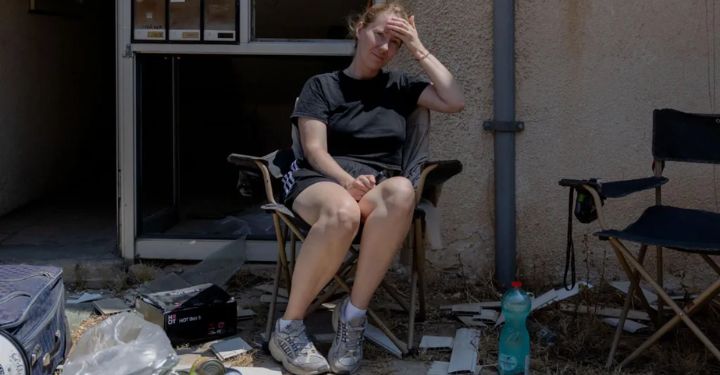
In the aftermath of Iran’s unprecedented missile attack on Israeli soil, calls for a decisive and sustained military response have echoed across the country. From Tel Aviv’s bomb shelters to the ruins of residential buildings in Ashkelon, Israeli citizens are voicing a common demand: protect us by striking back.
The conflict, which escalated rapidly after Israel reportedly targeted an Iranian weapons convoy in Syria last week, has plunged the region into one of its most serious confrontations in decades. Iran’s retaliatory attack involved over 100 missiles, many targeting densely populated areas and strategic military locations in Israel. While many were intercepted, several hit their targets, causing damage and casualties.
In a neighborhood of Ramat Gan that was struck by one of the missiles, 52-year-old engineer Shlomo Ben-David surveys the charred remnants of his apartment complex. “We’ve tolerated threats from Iran and Hezbollah for years,” he says. “This attack is a declaration of war. Our response should be just as clear.”
In many communities, there is little appetite for restraint. Polls taken just 48 hours after the missile barrage show that over 70% of Israelis support continued military action against Iranian targets, even at the risk of prolonged conflict. Analysts suggest this surge in public approval is rooted in a feeling of strategic necessity. “People believe deterrence has failed,” said Gili Dror, a defense analyst at Bar-Ilan University. “They want assurance that such an attack will never happen again.”
The Israeli government has already begun delivering that message. In a series of airstrikes over the last 48 hours, Israeli fighter jets targeted Iranian Revolutionary Guard Corps facilities, radar systems, and suspected nuclear development sites. Defense Minister Israel Katz stated that “this is not a symbolic gesture—this is the beginning of sustained operations until the threat is neutralized.”
Public support has remained strong even as fears of escalation mount. Air raid sirens continue to punctuate life in many cities, and emergency services are stretched thin. Yet instead of fracturing public opinion, the ongoing danger seems to be forging unity.
“Of course we’re afraid,” said 29-year-old nurse Yael Cohen as she handed out blankets to evacuees in Sderot. “But fear is not going to stop Iran. Only strength will.”
Israel’s allies have mostly supported its actions, though some world leaders are urging caution. Germany’s Chancellor called for “targeted, proportionate” responses, while the European Union’s foreign policy chief emphasized the need to avoid civilian casualties. Still, few in Israel see any path forward other than continued resistance.
Even in the political arena, where tensions are often fierce, a temporary consensus has emerged. Both the ruling Likud party and opposition factions have backed the government’s military strategy. “We cannot allow Iran to feel emboldened,” said opposition figure Avigdor Lieberman. “This is about the survival of the Jewish state.”
Though much remains uncertain—including how Iran may retaliate further—many Israelis appear resigned to a prolonged conflict. “This won’t end tomorrow,” said Avi Hadar, a university student from Haifa. “But it has to end on our terms. Otherwise, it never will.”
For More News updates : https://asiapedia.in