
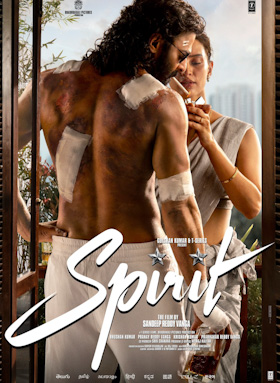
After the storm that was Animal, Director Sandeep Reddy Vanga is back again with the first look poster of Spirit released today, featuring Prabhas and Tripti Dimri. It marks a thrilling start to the new year 2026. He simply plants his flag again in territory that has always been his — intensity, intimacy, and discomfort. The poster functions less as a promotional image and more as a declaration. Vanga does not soften his visual language or recalibrate his themes to appease criticism. Instead, he reasserts his authorship, signaling that Spirit will operate on the same uncompromising wavelength that has made his films both controversial and impossible to ignore.
A Stark Return of Vanga to Familiar Territory
The poster is stark and confrontational. Prabhas appears battered and bruised, cigarette in mouth, alcohol in hand — a visual language instantly reminiscent of Animal. The bandages wrap around his body like unfinished battles. The similarities are impossible to miss: wounded masculinity, self-destruction, and silence doing the heavy lifting. Standing beside him, Tripti Dimri, the nationwide sensation since Animal, lights the cigarette. Her calm presence adds an unsettling intimacy to the frame.
Visually and thematically, the poster carries Vanga’s familiar signature — masculinity on edge, silence louder than dialogue, pain framed as character rather than spectacle. More or less fans are excited for this upcoming project by Vanga.
Symbolism, Discomfort, and Conversation after Spirit’s First Look
The presence of Tripti Dimri lighting the cigarette sparks discussions around symbolism, agency, and gender dynamics resurfacing almost immediately — proof that Vanga’s imagery still provokes rather than comforts. Love it or dislike it, the poster achieves one undeniable outcome: it demands attention and sparks conversation. In the aftermath of Animal—a film that thrived as much on controversy as on box-office numbers—such a response feels less like coincidence and more like design. With Spirit, the discourse begins even before the film does, making the debate an extension of the experience itself.
For More News updates : https://asiapedia.in