
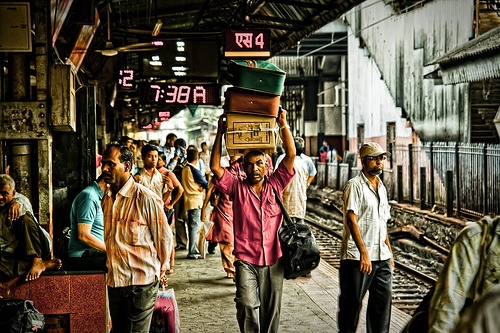
If you want to understand India without committing to a long journey, spend an hour on an Indian railway platform. Not rushing through it, not distracted by your phone, but watching. The platform compresses the country into a single stretch of concrete, where movement, waiting, class, emotion, and survival exist side by side.
The first lesson the platform teaches is that time behaves differently here. Some passengers arrive hours early, settling in as if the platform were an extension of home. Others sprint in at the last minute, trusting momentum over planning. Delays are announced, revised, ignored, accepted. Time is not something to control; it is something to negotiate.
Class reveals itself immediately, but not rigidly. There are people waiting in air-conditioned waiting rooms and others sleeping under open roofs. Business travellers stand with backpacks and earphones, while migrant workers sit in groups, sharing food wrapped in cloth. Yet the platform does not segregate completely. Everyone listens to the same announcements, drinks from the same water taps, waits under the same digital boards.
What becomes clear is that Indian society is not divided as neatly as it is often described. Differences coexist without constant conflict. The platform is a rare public space where proximity is unavoidable and tolerance becomes a daily practice rather than a moral statement.
Vendors move through this space like seasoned navigators. They understand hunger, urgency, and distraction instinctively. Their calls, chai, samosa, coffee, cut through noise with remarkable precision. These voices are not interruptions; they are part of the platform’s rhythm. They remind travellers that movement requires sustenance.
The platform is also deeply emotional, though it rarely announces this openly. Goodbyes happen quickly, without ceremony. Reunions are brief and practical. Tears are wiped away before trains arrive. Emotion here is efficient, felt fully but expressed briefly. There is no time for performance.
Children sleep on suitcases. Elderly passengers wait with quiet patience, trusting that someone will step in when help is needed. And usually, someone does. A stranger lifts luggage. Another shares information. Assistance happens without prolonged conversation. This is not altruism for applause; it is functionality born of repetition.
Indian railway platforms teach you about communication without excess words. People ask questions freely. Answers are given without suspicion. Directions are offered confidently, even when incomplete. Knowledge circulates orally, imperfectly, but generously.
Announcements echo overhead, often distorted, often late. People rely less on them than on observation. Eyes scan digital boards. Ears catch fragments of information. Intuition fills the gaps. This reliance on collective awareness rather than institutional clarity is deeply Indian. The platform is also a lesson in patience without passivity. People complain, but they wait. They adjust. They sit on the floor, lean against pillars, create temporary comfort in permanent uncertainty. Adaptability here is not celebrated, it is assumed.
At night, the platform transforms. Lights grow harsher, shadows longer. Conversations quieten. Sleep happens wherever possible. The platform becomes less about travel and more about endurance. And yet, even then, there is order. Trains arrive. People board. Life continues.
Perhaps the most striking lesson is that the platform does not belong to anyone, yet everyone claims it briefly. It is shared without ownership, occupied without attachment. People pass through carrying stories, burdens, hopes, and fatigue—but they leave without leaving marks. In an age obsessed with curated travel experiences, the Indian railway platform offers something else: unfiltered reality. No tickets to culture. No performances. Just people moving through necessity.
To understand India, you don’t need monuments or museums. Sometimes, all you need is one platform, one delayed train, and the willingness to wait.
For More News updates : https://asiapedia.in