
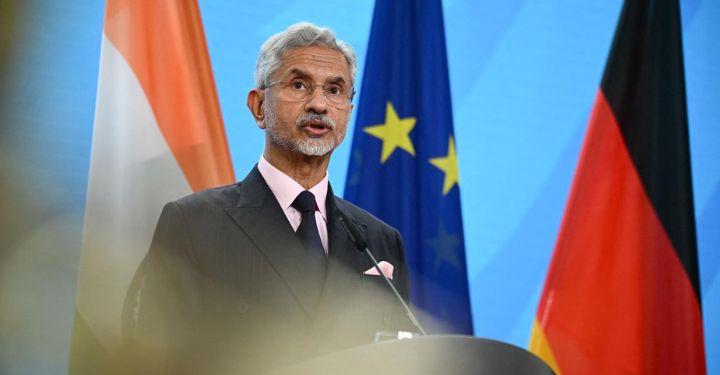
At the prestigious Munich Security Conference 2025, Indian External Affairs Minister Dr. S. Jaishankar delivered a firm and unambiguous message on India’s global security policy. Reinforcing India’s zero-tolerance stance on terrorism, Jaishankar stated categorically that India would never submit to nuclear blackmail, regardless of the source or circumstance. His remarks came in the context of heightened tensions in South Asia following the Pahalgam terror attack that claimed 26 lives and India’s subsequent military response through ‘Operation Sindoor.’
Speaking before a global audience comprising world leaders, diplomats, and security experts, Jaishankar emphasized that terrorism remains one of the gravest threats to international peace and stability. “No cause justifies terror,” he declared. “It cannot be cloaked in political grievance or religious radicalism. We must act together, without hesitation or selectivity.”
The Indian minister’s comments were especially significant in light of increasing concerns over state-sponsored terrorism from neighboring Pakistan, and the use of nuclear rhetoric by some Pakistani leaders in recent years. While he refrained from directly naming Pakistan during his main address, Jaishankar’s references were unmistakable. “We have faced decades of cross-border terrorism. Our policy is clear: those who perpetrate terror or harbor terrorists will face consequences.”
‘Operation Sindoor,’ which targeted nine terror camps in Pakistan and Pakistan-occupied Jammu & Kashmir (PoJK), was India’s answer to the Pahalgam massacre—a coordinated series of attacks by militants on civilians and security personnel. Jaishankar described the operation as “measured, precise, and necessary,” and reiterated India’s right to self-defense under Article 51 of the UN Charter.
In Berlin, where the conference was hosted, Jaishankar held crucial side-line meetings with counterparts from France, Germany, Spain, Japan, and Qatar. All five countries expressed their solidarity with India and acknowledged New Delhi’s responsible handling of a volatile situation. Many also backed India’s calls for stronger international frameworks against cross-border terrorism and reiterated their support for the Financial Action Task Force’s (FATF) pressure on countries that shelter terror networks.
In the face of renewed nuclear rhetoric from certain officials in Islamabad, Jaishankar made it clear that India would not be coerced. “India will never give in to nuclear blackmail. Our national integrity, sovereignty, and the lives of our people are non-negotiable,” he said.
The Munich audience responded with visible support, with several Western diplomats reportedly praising India’s restrained yet robust response. Analysts have noted that India’s articulation of its position at such international forums is part of a broader strategy to highlight the inconsistencies of global powers that selectively condemn terrorism while staying silent on Pakistan’s role.
Jaishankar also reiterated India’s long-held position that any dialogue with Pakistan must occur bilaterally, without third-party mediation. “There should be no confusion in any quarter about our policy,” he asserted. “The Simla Agreement and the Lahore Declaration are our guiding principles. We do not require intermediaries.”
The minister’s comments come amid increasing chatter about attempts by certain global powers to nudge India and Pakistan toward talks. However, India’s firm policy remains unchanged: talks and terror cannot go hand in hand.
Beyond the regional security issues, Jaishankar also touched upon broader global concerns such as the weaponization of supply chains, digital terrorism, and the spread of radical ideologies online. He argued that just as nations cooperate to counter climate change and pandemics, they must also unify against terrorism.
The speech resonated strongly across media in India and internationally. Commentators pointed out that Jaishankar’s speech underscored India’s emergence as a mature and assertive power that is capable of handling its own security challenges without external crutches.
In conclusion, Jaishankar’s address in Germany was a reaffirmation of India’s clarity, conviction, and commitment to peace through strength. With a combination of diplomacy and decisive action, India has sent a clear message to the world: terrorism will be met with zero tolerance, and sovereignty will never be compromised.
For More News updates : https://asiapedia.in