
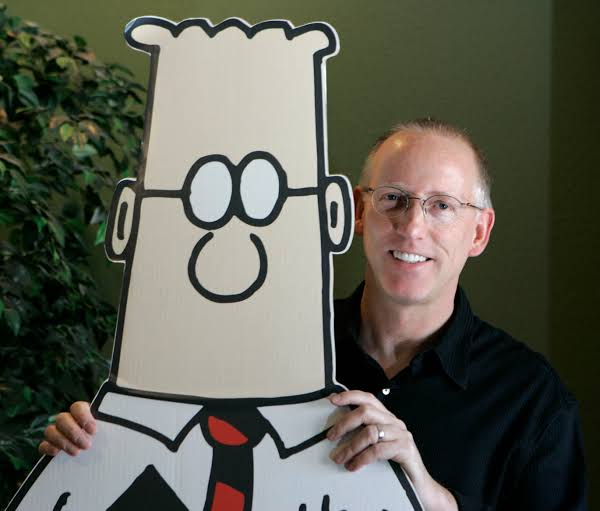
Scott Adams death at the age of 68 has marked a heartbreaking moment for fans of the iconic Dilbert comic strip. The legendary cartoonist passed away after a long battle with prostate cancer that had spread to his bones.
Scott Adams, the creator of the globally popular comic strip Dilbert, has died at the age of 68 after a prolonged battle with prostate cancer that had spread to his bones. His passing was confirmed by his ex-wife, Shelly Miles, during a livestream, bringing a quiet but emotional close to the life of a man whose Scott Adams death work defined modern corporate satire for more than three decades.
Scott Adams Death: The Man Who Redefined Workplace Satire
In recent months, Adams had been open and unflinching about his declining health. He spoke candidly to his followers about the severity of his condition, even stating publicly that his chances of recovery were “essentially zero.” True to his lifelong approach, he faced the reality with blunt honesty rather than denial, choosing transparency over silence Scott Adams death
For millions around the world, Scott Adams was not just a cartoonist. He was a sharp observer of office life, hierarchy, and human absurdity — someone who captured the frustrations, contradictions, and quiet humor of the modern workplace with uncanny precision.
A Comic Strip That Spoke for a Generation
When Dilbert first appeared in 1989, it arrived at a moment when corporate culture was rapidly evolving. Office cubicles, middle management jargon, endless meetings, and performance reviews were becoming everyday realities for white-collar workers. Adams turned these experiences into comedy, but not in a loud or exaggerated way. His humor was subtle, often uncomfortable, and painfully accurate Scott Adams death.
The strip’s central character, Dilbert, was an engineer trapped in a maze of pointless rules and clueless bosses. Around him were characters like the Pointy-Haired Boss, whose lack of competence became a symbol of corporate leadership gone wrong, and Dogbert, whose cynical intelligence often exposed the darker side of ambition and power Scott Adams death
What made Dilbert resonate was not just its jokes, but its recognition of shared experience. Readers didn’t feel laughed at — they felt seen.
Hollywood celebrity deaths
https://asiapedia.in/category/entertainment/
At its peak, Dilbert was published in thousands of newspapers across dozens of countries. It was translated into multiple languages, adapted into books, calendars, and even an animated television series. For many professionals, it became a daily ritual: a quick glance at the comic strip that perfectly captured what their workday felt like Scott Adams death
Beyond Humor: A Cultural Mirror
Adams’ work went beyond simple satire. Dilbert became a cultural mirror reflecting how organizations functioned — or failed to function. The strip questioned authority, mocked meaningless corporate language, and highlighted how intelligence often went unrewarded in bureaucratic systems Scott Adams death
This ability to criticize without preaching made Adams influential far beyond the comics page. Business leaders referenced Dilbert in management discussions, while employees used it as a quiet form of resistance — a way to laugh at systems they couldn’t change.
Adams himself often said he didn’t set out to attack corporations. Instead, he exaggerated real behaviors just enough to reveal the truth underneath. That honesty became his trademark Scott Adams death
A Public Battle With Illness
In the later years of his life, Adams’ health struggles became increasingly public. Diagnosed with prostate cancer that eventually spread to his bones, he chose not to hide his condition. Through livestreams and online posts, he shared updates with a matter-of-fact tone, often acknowledging the emotional weight without dramatizing it Scott Adams death
When he told followers that recovery was no longer possible, it wasn’t framed as a plea for sympathy. It was simply another example of Adams confronting reality head-on — the same way he had confronted corporate absurdity through his work.
Scott Adams
https://en.wikipedia.org/wiki/Scott_Adams
Scott Adams, best known as the creator of Dilbert, built a global fanbase through his sharp corporate satire.
His ex-wife, Shelly Miles, confirmed his death during a livestream, a moment that quickly spread across social media and news platforms. Tributes poured in from readers, artists, and professionals who grew up with Dilbert as part of their daily routine Scott Adams death.
A Complicated and Lasting Legacy
While Adams’ creative influence is undeniable, his later years were also marked by controversy surrounding his personal views and public statements. These moments complicated his public image and sparked debate about separating art from the artist Scott Adams death
Yet even critics acknowledge the cultural impact of Dilbert. The strip fundamentally changed how workplace humor was approached and influenced countless writers, cartoonists, and comedians who followed.
For many readers, Dilbert remains frozen in time — a snapshot of office life that still feels relevant decades later. Meetings still run long. Corporate language is still vague. Employees still struggle to be heard. In that sense, Adams’ work continues to speak long after its creator is gone Scott Adams death
Remembering the Man Behind the Strip
Scott Adams lived a life shaped by observation. He watched how people behaved under pressure, how power distorted logic, and how humor could make uncomfortable truths easier to face. He turned those observations into simple drawings that carried sharp insight Scott Adams death
His death at 68 marks the end of a chapter in the history of modern satire, but his work endures in cubicles, offices, and shared links across the internet. Every time someone looks at a Dilbert strip and says, “This is exactly my office,” Adams’ voice echoes on.
In the end, Scott Adams didn’t just make people laugh. He helped them understand their world — one panel at a time.
For More News updates : https://asiapedia.in