
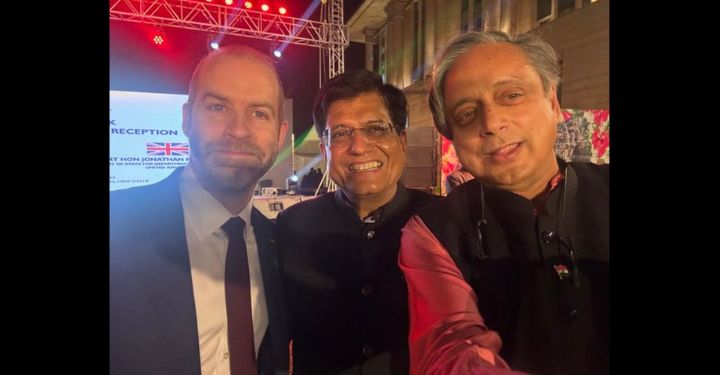
In the fast-moving world of social media, where a single post can spark widespread discussion, a seemingly innocent selfie has the power to ignite intense debates. That is exactly what happened when Congress MP Shashi Tharoor shared a selfie with Union Minister Piyush Goyal amidst ongoing political controversies in Kerala. The photo, featuring the two leaders from opposing political parties, took the internet by storm, prompting a series of reactions from both political supporters and critics.
Tharoor, a prominent leader in the Congress Party and known for his diplomatic and often sharp political commentary, posted the selfie alongside Goyal, who serves as a senior member of the BJP and holds the position of Minister for Commerce and Industry. The photo, which showed both men smiling and enjoying each other’s company, was at odds with the tense political climate in Kerala. The state is currently embroiled in a variety of political controversies, making Tharoor’s post particularly noteworthy.
The Political Context: Kerala’s Turmoil and Its Impact on National Politics
Kerala’s political landscape has long been defined by the dominance of the Left Democratic Front (LDF), led by the Communist Party of India (Marxist), and the United Democratic Front (UDF), which is led by Congress. While the two parties often clash over local issues, there has also been a strong presence of national parties, particularly the BJP, which has gradually increased its footprint in the state. Kerala, which has historically leaned left, has seen rising challenges as national parties like the BJP attempt to alter the political balance.
At the heart of the current controversy is the handling of Kerala’s economic policies and governance. The LDF government’s response to issues like unemployment, health care, and infrastructure development has come under increasing scrutiny. In contrast, the Congress party, with Tharoor as one of its vocal leaders, has consistently criticized the government’s inability to address these challenges effectively. The BJP, through leaders like Piyush Goyal, has seized on this growing discontent and positioned itself as an alternative to the traditional political parties in Kerala.
It is in this heated political environment that the selfie between Tharoor and Goyal emerged. On the surface, the image could be seen as nothing more than an innocuous moment of personal camaraderie between two politicians. However, in a state where every political move is dissected, the timing of the photo raised eyebrows. Many saw it as a message—whether deliberate or accidental—that could shift public perception of the two leaders’ political affiliations.
The Reactions: Mixed Responses from All Corners
The selfie, once posted, did not take long to garner attention. On social media, reactions were immediate, with the public divided in their responses. Supporters of Tharoor were quick to question the appropriateness of the post, given the ongoing political tension in Kerala. Many felt that the image, showing two major political figures from opposing parties enjoying a friendly moment together, sent a confusing signal, especially when Tharoor had been vocal about the BJP’s policies in Kerala.
The Congress, which has had a contentious relationship with the BJP at both the state and national levels, found itself in a difficult position. Some party members expressed concerns that Tharoor’s selfie would be interpreted as a sign of tacit approval for the BJP’s agenda. Given that Tharoor is considered a senior leader in Congress, his actions are often viewed through the lens of party politics, and any deviation from the party’s stance can have significant repercussions.
On the other side, BJP supporters were quick to praise the gesture. They saw the selfie as a symbol of political maturity, one that demonstrated that even politicians from opposing parties could find common ground. In a political climate where partisan divides often lead to personal animosities, the image of Tharoor and Goyal laughing together suggested a more collaborative approach to politics. For BJP supporters, the photo reinforced the idea that dialogue between different factions could lead to better governance.
However, some observers argued that the timing of the selfie was too politically charged to be purely about personal friendship. Critics of Tharoor suggested that the photo could be seen as a subtle attempt to soften his stance against the BJP. The selfie could also be interpreted as a way for Tharoor to appear more moderate or conciliatory, potentially influencing voters in Kerala who are frustrated with the continued political polarization. In a state where every political move is carefully scrutinized, even a harmless photo can have significant implications.
Political Strategy or Simple Friendship?
The question that many asked after seeing the photo was whether it represented a calculated political strategy or simply a moment of personal camaraderie between two men who share mutual respect. Tharoor, known for his diplomatic skills and eloquent communication, has often positioned himself as a bridge between opposing views. While he has been a staunch critic of the BJP on numerous occasions, particularly with regard to the party’s policies affecting Kerala, Tharoor has also advocated for a more inclusive political discourse. Could this selfie be a manifestation of that approach?
Conversely, it could be seen as an effort by Tharoor to distance himself from the more radical elements within his own party, especially at a time when Congress is struggling to gain traction against the BJP. With the Congress grappling with its identity and struggling to present a united front, Tharoor’s friendly interaction with Goyal might be viewed as an attempt to create space for himself as a more centrist figure within the party. His willingness to engage with BJP leaders could be seen as a sign that he is not completely opposed to collaboration, even with a rival party, for the sake of Kerala’s progress.
For Goyal, the selfie served as an opportunity to present a more approachable and cooperative image. Often associated with hardline politics and economic policies that have been criticized by various sections of society, Goyal’s lighthearted moment with Tharoor could be a way to soften his image. The post allowed Goyal to project an image of a politician who values respectful relationships with all leaders, regardless of their political affiliation.
The Role of Social Media in Modern Politics
This incident underscores the significant role social media plays in shaping modern-day political narratives. In an era where a single tweet, post, or photo can go viral and have lasting effects on public opinion, politicians are constantly aware of how their actions are being perceived. Tharoor’s selfie with Goyal is a perfect example of how social media can magnify even the smallest of moments, turning them into major political discussions.
It also speaks to the growing importance of personal branding in politics. Politicians today are not just selling their party’s agenda—they are also selling themselves as individuals. Tharoor, known for his online presence and literary persona, has always been conscious of his image, and the selfie with Goyal could be seen as an attempt to communicate his personal brand as one that transcends ideological divides.
Conclusion: An Unlikely Friendship or Political Play?
As the dust settles, the selfie shared by Shashi Tharoor and Piyush Goyal continues to spark discussions. Was it a genuine display of friendship and respect between two politicians, or was it a carefully orchestrated move to influence public perception in Kerala? Only Tharoor and Goyal know the full story behind the photo. What is clear, however, is that this seemingly harmless moment has provided a snapshot of the evolving political dynamics in Kerala and India at large. Whether viewed as an attempt to soften political lines or simply a friendly gesture, the selfie has become an unlikely symbol of the complexities of contemporary politics.
For More News updates : https://asiapedia.in