
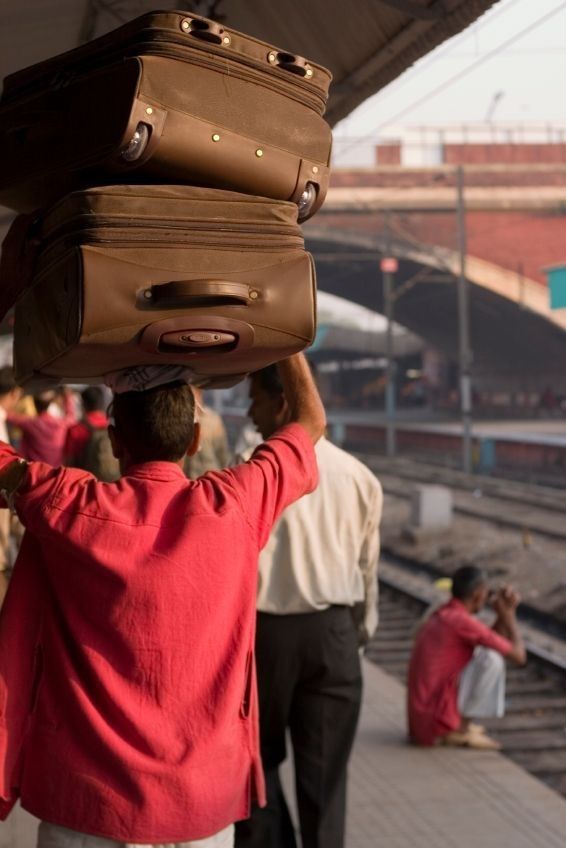
When we think of travel in India, we remember stations, roads, buses, trains, landscapes, and crowds. What we rarely remember, unless something goes wrong, is the labour that holds all of it together.
Indian travel does not move on schedules alone. It moves on people.
Before a train arrives, someone has already cleaned the platform at dawn. Before a bus departs, someone has checked tyres, wiped seats, shouted destinations into the morning air. Before you lift your luggage, someone else has been carrying dozens just like it for hours.
This work rarely appears in travel stories, yet it is the spine of mobility in India.
Railway porters are often the first to arrive and the last to leave. They know platforms better than maps. They remember train numbers, coach positions, last-minute changes. For many travellers, elderly passengers, families, solo women, people carrying their lives in bags, these workers turn stress into movement. Their labour is physical, but also mental and emotional.
Cleaners operate in cycles invisible to passengers. They reset spaces constantly, stations, waiting rooms, toilets, compartments, so that movement can continue. Their work is repetitive, undervalued, and essential. Without it, travel would grind to a halt within hours.
Ticket clerks and reservation staff sit at the crossroads of urgency and confusion. They absorb frustration, panic, impatience, and relief daily. A missed connection becomes their problem. A wrong booking becomes their responsibility. They translate complex systems into quick decisions under pressure.
Then there are night guards, drivers, signal operators, toll booth staff, ferry workers, helpers at bus stands, people whose labour unfolds while most travellers sleep or scroll. They work in shifts that stretch across heat, rain, festivals, strikes, and emergencies. Travel in India continues because someone is always awake.
What makes this labour distinct is its human elasticity. Rules exist, but adjustment keeps things moving. A guard allows early entry. A driver waits two extra minutes. A helper calls out your destination louder than required. These acts are not in job descriptions, yet they define the travel experience.
Technology has changed systems, but not dependency. Apps can book tickets, but they can’t lift luggage, manage crowds, or calm anxious travellers. Even in digital travel, labour adapts, scanning QR codes, explaining processes, guiding people unfamiliar with screens.
This invisible work also reflects India’s broader labour reality. Many workers are underpaid, informal, and unrecognised. Yet their pride often comes from competence. Knowing the system becomes power. Knowing people becomes currency.
Travel exposes this truth sharply: mobility is collective. One person moves because many others make space, manage flow, and absorb strain.
When a journey goes smoothly, we credit luck or planning. When it fails, we look for someone to blame. Rarely do we pause to acknowledge how much effort it takes to make movement feel ordinary.
Indian travel is not self-operating. It is hand-operated, voice-coordinated, body-driven. It works not because systems are perfect, but because people compensate constantly.
To notice this labor is not to romanticize hardship. It is to recognize reality. Every arrival rests on unseen effort. Every departure carries the weight of work done quietly, repeatedly, without applause.
India moves because its workers keep it moving, even when no one is watching.
For More News updates : https://asiapedia.in