
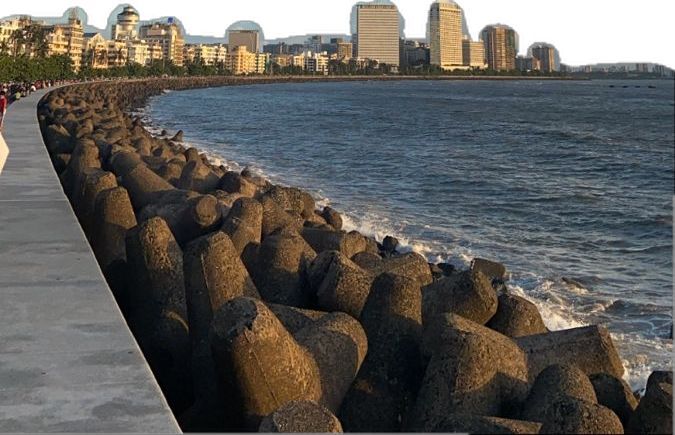
Marine Drive is often described as a place to visit, but for Mumbai, it has never functioned that way. People do not arrive here with checklists or expectations. They come empty, tired, overstimulated, and quietly hopeful. Marine Drive is not where journeys begin or end, it is where they loosen their grip.
This curved stretch of road does not promise anything dramatic. There are no grand gates, no entry rituals, no rules of engagement. Yet every evening, the city drifts here instinctively. Office workers loosen their collars. Students sit cross-legged with headphones in. Elderly couples hold silence like a shared language. The sea does not entertain, it absorbs.
What makes Marine Drive different from other urban promenades is its emotional neutrality. No one asks who you are here. You can arrive after a bad day, a breakup, an exam failure, or a small personal victory, and the place responds the same way, with space. In a city that constantly demands movement, Marine Drive offers permission to stop without explanation.
The relief it provides is not scenic; it is psychological. Mumbai lives at a high frequency, trains arriving every few minutes, deadlines stacked on deadlines, conversations overlapping. Marine Drive interrupts that frequency. The soundscape shifts. Traffic becomes distant background noise. The sea introduces a slower rhythm that the body begins to match unconsciously.
This is why people come alone. Marine Drive is one of the few public spaces in India where solitude does not look suspicious. Sitting alone here does not signal loneliness; it signals intention. People journal, stare, breathe, cry quietly, or do absolutely nothing. The city does not intrude.
At night, Marine Drive transforms further. The famous “Queen’s Necklace” view is rarely the point for locals. What matters is the darkness between lights, the sense that the city, for a moment, is not watching itself perform. Conversations here are softer, often unfinished. Some are never spoken at all.
Marine Drive also functions as an equalizer. College students sit a few feet away from corporate executives. Tourists blend into locals without ceremony. No one owns the view; no one curates the moment. This shared access to pause is rare in Indian cities, where space is often treated as a commodity.
In recent years, as conversations around mental health, burnout, and overstimulation have grown louder, Marine Drive’s relevance has deepened. It is not marketed as a wellness destination, yet it performs emotional regulation effortlessly. No apps, no instructions, just presence.
Travel writing often focuses on movement, discovery, and novelty. Marine Drive challenges that idea. It proves that sometimes, the most meaningful places are not about seeing something new but about feeling less burdened by what already exists.
For Mumbai, Marine Drive is not escapism. It is recalibration. A reminder that even in one of India’s most relentless cities, there is a curve where urgency dissolves, and breathing becomes enough.
For More News updates : https://asiapedia.in