
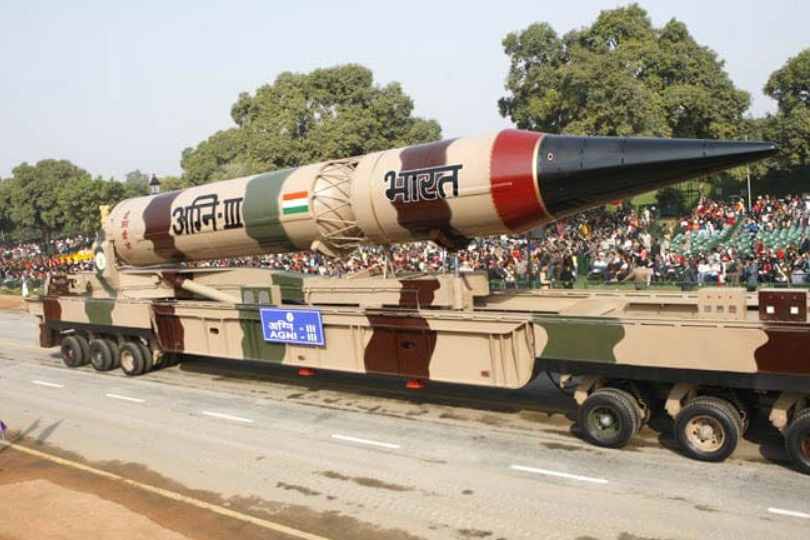
India achieved a major defense milestone on February 7, 2026, with the successful test-fire of the Agni-3 medium-range ballistic missile from Abdul Kalam Island off Odisha’s coast. Launched by the DRDO, this nuclear-capable missile boasts a 3,000-3,500 km range, capable of striking deep into Pakistan or parts of China from Indian bases. The user-configurable trajectory validated enhanced navigation and re-entry systems, reinforcing India’s credible minimum deterrence amid rising regional threats.
The test gains urgency from fresh Indo-Pak tensions sparked by a devastating mosque blast in Islamabad, killing dozens and prompting Pakistan’s accusations of Indian involvement, claims New Delhi firmly denies. Agni-3’s precision upgrades, including ring-laser gyro inertial systems, ensure reliable strikes on high-value targets like terror camps or military hubs. Coming weeks after Pakistan’s own missile drills, this flexes India’s second-strike capability, vital post the 2019 Balakot airstrikes and recent border skirmishes. Defense experts hail it as a “force multiplier,” deterring escalation while upholding a no-first-use policy.
Globally, the timing syncs with high-stakes US-Iran nuclear talks in Oman, where Tehran resists curbs on its ballistic program amid stalled JCPOA revival. President Trump’s fiery X posts, labeling Iran’s missile advances a “red line” and praising India’s tests as “smart power”, underscore shifting alliances. The US has fast-tracked tech transfers to India under QUAD frameworks, viewing Agni-3 as a counter to China’s DF-21D carriers in the Indian Ocean. This convergence highlights Asia-Pacific volatility, from South China Sea frictions to Houthi disruptions rerouting 12% of global oil.
For India, Agni-3 integrates into the canisterized Agni series, enabling rapid road-mobile launches for surprise deterrence. Costing under ₹50 crore per unit, it bolsters the Strategic Forces Command’s arsenal alongside Agni-5’s 5,000+ km reach. Public mood swells with pride, mirroring Chandrayaan-3’s triumph, as PM Modi lauds DRDO scientists. Critics note proliferation risks, urging arms control dialogues, but successes like this cut import reliance by 70% since Atmanirbhar Bharat.
Strategically, it recalibrates power balances: Pakistan accelerates Ababeel MIRV tests, while China eyes hypersonic gaps. Trump’s rhetoric may spur Indo-US joint exercises like Tiger Triumph 2026. As Oman talks falter, Agni-3 signals India’s readiness, technical prowess meets geopolitical resolve, safeguarding 1.4 billion lives in an era of flashpoints. This isn’t just a launch; it’s a statement of sovereign strength.
For More News updates : https://asiapedia.in