
Pahalgam, Jammu and Kashmir | April 23, 2025 —
A deadly terror attack in the scenic town of Pahalgam, Jammu and Kashmir, on April 22 has left the country in mourning. The assault, which occurred in the Baisaran Valley, resulted in the death of 28 people, including tourists from across India and abroad. Over 20 others were injured in the attack, sparking widespread outrage. In the aftermath, Union Home Minister Amit Shah visited the region to pay his respects to the victims and assured the public that the perpetrators would face swift and decisive justice.
The Attack: A Brutal Assault on Innocent Civilians
The terror attack took place in the afternoon when a group of tourists was trekking through Baisaran Valley, one of Pahalgam’s most popular tourist destinations. Known for its breathtaking views, the valley has been a peaceful haven for travelers. However, on April 22, that peace was shattered when militants ambushed the tourists.
Eyewitnesses reported that the assailants, disguised as civilians, suddenly opened fire on the unsuspecting group from nearby wooded areas. Panic spread rapidly as tourists tried to flee, but many were trapped in the hilly terrain and fell victim to the gunfire. The attack resulted in 28 fatalities, including people from various Indian states such as Maharashtra, Punjab, Gujarat, and West Bengal. Among the dead were also three foreign nationals—a Nepali couple and a tourist from the United Arab Emirates.
At least 20 others were injured, with several in critical condition. Some victims had to be airlifted to hospitals in Srinagar and Anantnag for medical treatment. The attack has sent shockwaves through the nation, particularly as it targeted innocent tourists visiting the region.
Amit Shah’s Visit: Condolences and Firm Response
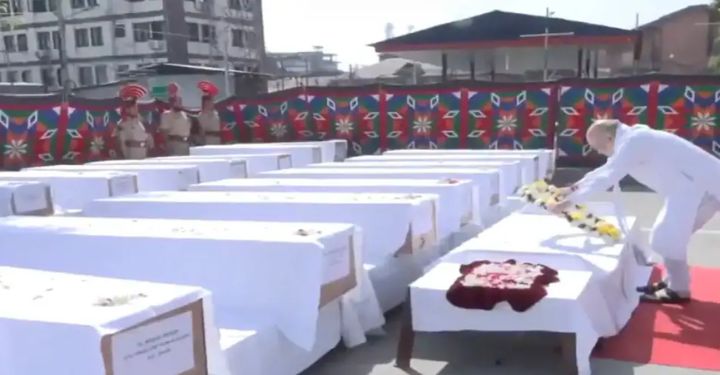
Union Home Minister Amit Shah arrived in Srinagar on Tuesday, the day after the attack. He immediately headed to Pahalgam to visit the site of the tragedy and pay tribute to the victims. In a solemn ceremony, Shah laid a wreath at a temporary memorial erected in honor of those killed and observed a moment of silence to express solidarity with the grieving families.
Shah then visited the injured at Sher-i-Kashmir Institute of Medical Sciences (SKIMS) in Srinagar. He met with survivors and their families, offering assurances of support from the central government. Speaking to the media, he condemned the attack as a “cowardly act” and reaffirmed the government’s commitment to bringing those responsible to justice.
“This is a cowardly attack targeting innocent civilians. The terrorists behind this brutal act will not be allowed to escape justice,” Shah said in a press briefing. “We will ensure full security for tourists and the people of Jammu and Kashmir. There will be no leniency in dealing with terrorism.”
Investigation and Security Measures
In the wake of the attack, the Jammu and Kashmir Police, along with the Army and paramilitary forces, launched an extensive manhunt for the militants involved. Initial investigations suggest that the attack was carried out by operatives of The Resistance Front (TRF), a Pakistan-based terror group that has previously targeted civilians and security forces in the region.
The militants reportedly infiltrated the area using forest routes and attacked the tourists, exploiting the remote location’s relative lack of heavy security. The TRF, a faction linked to the infamous Lashkar-e-Taiba (LeT), has been responsible for several terror-related activities in Kashmir, and authorities suspect that this latest attack was aimed at creating fear and disrupting the region’s recovering tourism industry.
The National Investigation Agency (NIA) has now taken charge of the investigation. Forensic teams have begun analyzing the weapons and devices found at the scene, while security forces have intensified their search operations across the valley, particularly in the districts of Anantnag, Pulwama, and Shopian, which are known hotspots for militant activity.
In addition to the increased military presence, the Ministry of Home Affairs (MHA) has announced plans to review and enhance security measures in tourist-heavy areas of Jammu and Kashmir. Drones, satellite imaging, and other surveillance methods are being employed to track down the militants and gather vital intelligence.
Political and Public Reactions
The attack has sparked widespread condemnation across the political spectrum. Prime Minister Narendra Modi expressed his sorrow over the loss of life and pledged that the government would not rest until the terrorists were brought to justice. “This cowardly attack will not break our resolve,” Modi said in a statement. “The entire nation stands with the families of the victims, and we will not allow terrorism to succeed in dividing us.”
Opposition leaders have also voiced their outrage. Congress President Mallikarjun Kharge called for a comprehensive review of security protocols in the region, while Delhi Chief Minister Arvind Kejriwal extended his condolences to the families affected by the attack. Leaders from across the political spectrum urged the government to take stronger action to combat terrorism in Kashmir.
Social media has been flooded with messages of grief, support, and solidarity. Hashtags such as #PahalgamAttack and #JusticeForVictims trended on platforms like Twitter and Instagram, with citizens across the country expressing their outrage and calling for immediate action.
Impact on Kashmir’s Tourism and Local Economy
The attack has had a significant impact on the local economy, particularly in Pahalgam, which is heavily reliant on tourism. After the attack, there was a noticeable decline in the number of tourists visiting the region, as travelers canceled their bookings and decided to return home.
Local businesses, including hotels, restaurants, and tour operators, have expressed concern over the long-term effects of the attack on the region’s tourism industry. Nazir Ahmad, a hotel owner in Pahalgam, expressed his frustration: “This attack has destroyed the progress we had made. Tourists were finally starting to return, and now there is fear once again.”
To provide immediate relief, the Jammu and Kashmir government has announced compensation of ₹10 lakh for the families of those killed and ₹2 lakh for those seriously injured. Additionally, trauma counseling services are being offered to the victims’ families, and efforts are being made to support the local economy through initiatives aimed at boosting tourism in the future.
The Road Ahead
The Pahalgam attack has raised serious concerns about the ongoing security situation in Jammu and Kashmir, especially as the region recovers from years of instability. Despite significant progress in recent years, terrorism continues to remain a major threat, and the government has reiterated its commitment to tackling the problem head-on.
Union Home Minister Amit Shah concluded his visit with a message of resolve: “We will ensure that Kashmir remains a peaceful place, and the people of this region are not harmed by these terrorists. We will continue our fight against terrorism until peace is restored.”
The government’s response to the Pahalgam attack is likely to shape the future of security measures in the region, as authorities focus on protecting tourists and ensuring the safety of civilians in the face of persistent terror threats.
For More News updates : https://asiapedia.in