
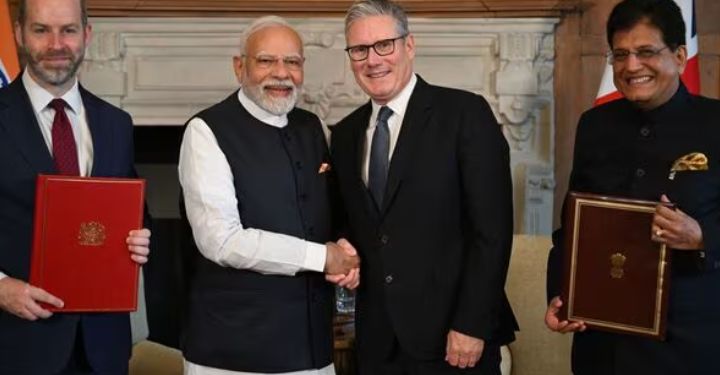
In a turning point for bilateral relations, Prime Ministers Narendra Modi and Keir Starmer today signed a landmark Free Trade Agreement. The accord, aimed at doubling trade to roughly $120 billion by 2030, removes tariffs on virtually all Indian exports and dramatically lowers duties on key UK goods—boosting growth, jobs, and consumer choice in both countries.
A Decade in the Making
Negotiations for the India–UK Free Trade Agreement began in January 2022 and unfolded over 15 formal rounds before culminating in today’s signing ceremony in London, attended by PM Modi and PM Starmer. The pact also includes a “double contribution convention” (social security agreement), marking a mutual commitment to deepening the bilateral “Comprehensive Economic and Trade Agreement”.
Tariffs Slashed: Key Cuts & Market Access
- UK Exports to India: India will slash tariffs on approximately 90% of British goods—from an average of 15% to around 3%. Tariffs on Scotch whisky and gin will be halved immediately to 75% and fall to 40% within a decade. Duties on automobiles fall from over 100% to 10% under a phased quota system.
- Indian Exports to UK: The UK will eliminate tariffs on 99% of Indian export lines, covering labour-intensive sectors such as textiles, footwear, gems & jewellery, marine goods, sports goods, auto components, furniture, chemicals, and machinery—goods currently subject to 4–16% tariffs in the UK.
Economic Payoffs & National Gains
- Trade Growth: By 2040, bilateral trade is expected to rise by £25.5 billion (approx. $34 billion) annually compared to projections without the deal.
- UK GDP Boost: UK GDP is forecast to increase by £4.8 billion per year, with wages rising by £2.2 billion and tax revenues by £1.8 billion over time.
- Job Creation: The UK government estimates over 2,200 new jobs, especially in aerospace, advanced manufacturing, clean energy, and professional services sectors.
How Each Side Wins
India:
- MSMEs and labour‑intensive industries stand to benefit the most, with textiles, leather, gems & jewellery, marine products, and sports goods all gaining duty-free UK access. That should spur export growth of 30–45% by 2030, aligning with New Delhi’s export doubling target of ~$120 billion.
- Sectors that retain protection (e.g. dairy, apples, cheese) mean Indian farmers’ interests are safeguarded.
- The social security pact exempts Indian professionals in the UK from double national insurance contributions for up to three years, saving around ₹4,000 crore annually (~$460 million).
- Services mobility extends to yoga teachers, chefs, musicians, and business visitors, boosting cultural and trade links.
UK:
- UK exporters in whisky, gin, cars, medical devices, cosmetics, and aerospace firms will face much lower tariffs in India, expanding their competitive edge in South Asia’s fastest-growing market.
- Access to Indian public procurement — estimated at £38 billion annually — opens doors for UK firms across sectors like transport, healthcare, energy, and infrastructure.
- Clean energy and financial services benefit from “brand new, unprecedented” access and stabilized foreign investment caps, providing market access and certainty in regulatory terms.
Strategic & Political Dimensions
The deal is being described by UK officials as the most important since Brexit, while Modi termed it “historic milestone” and a blueprint for shared prosperity. Starmer reiterated that the deal implements his “Plan for Change,” putting more money into pockets of working people and raising living standards across regions.
Political critics, particularly from the UK Conservative Party, have raised concerns over the social security exemption as creating a “two‑tier” system favoring Indian professionals—a point drawing heated debate in recent commentary.
Negotiators have also positioned the agreement as a key component of the broader India–UK Vision 2035, encompassing cooperation in innovation, aerospace, clean technology, AI, defence, and intelligence sharing—enhancing the strategic footprint beyond just economic gains.
Nonetheless, not all issues are fully resolved. A proposed bilateral investment treaty remains under negotiation, with India resisting longer protections demanded by the UK. The deal also avoids commitments around carbon border adjustment taxes, which could affect carbon-intensive exports like steel and aluminium.
Implementation Path & Outlook
- The agreement, formally signed today with commerce ministers in attendance, now awaits legal clearance from both governments and ratification by the British Parliament and India’s Union Cabinet. Full implementation is expected to take up to a year.
- Post-ratification steps include phased tariff roll-outs, professional mobility protocols, regulatory alignment in services and intellectual property, and procedural clarity over procurement and visa access.
- If implemented smoothly, this FTA sets a precedent for India’s future talks with the US, EU, and ASEAN—and for the UK’s global trading strategy beyond Europe.