
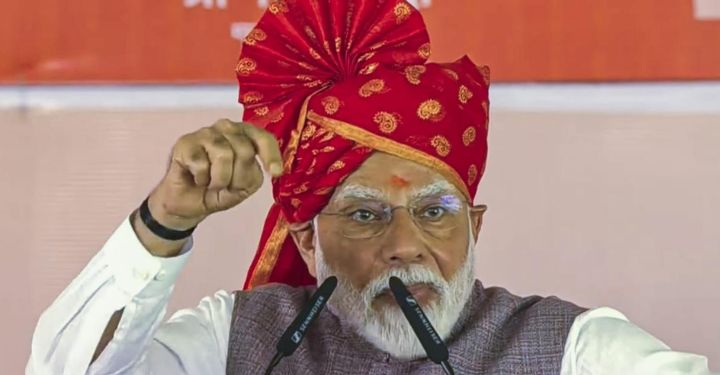
In a powerful and emotionally charged address in Bikaner, Prime Minister Narendra Modi made a bold declaration that resonated across the nation: “When our sindoor is targeted, it turns into barood.” The statement, aimed directly at Pakistan and its continued support for cross-border terrorism, was a sharp reminder of India’s evolving defense posture—swift, precise, and unapologetic.
This came on the heels of Operation Sindoor, a rapid military operation carried out by India in response to the recent Pahalgam terror attack. The operation saw nine terrorist training camps obliterated in under 30 minutes, a move Modi described as “an answer written not in words, but in action.”
The Meaning Behind the Metaphor: Sindoor to Barood
The symbolism of “sindoor” in Indian culture runs deep. It is traditionally worn by married Hindu women as a mark of sacred union, love, and protection. By referencing sindoor, Modi invoked not just emotion, but national pride, dignity, and sanctity. He connected cultural sentiment with military strength—turning a symbol of grace into one of grit.
“When enemies target our innocence, our symbols of peace and pride, they should know—they awaken a force that knows no fear,” Modi told the crowd in Bikaner, a region steeped in military heritage and nationalist sentiment.
His message was clear: India’s tolerance should not be mistaken for weakness. When provoked, the country transforms its inner resolve—represented by sindoor—into outward strength—represented by barood (gunpowder).
Operation Sindoor: Tactical Response, Strategic Impact
Operation Sindoor, executed in response to the May 5 terror attack in Pahalgam, was a meticulously planned tri-services mission. According to defense officials, Indian intelligence agencies tracked specific camps linked to the groups responsible—Lashkar-e-Taiba and Jaish-e-Mohammed among them.
In the early hours of May 8, Indian forces launched coordinated strikes on nine sites across Pakistan-occupied Kashmir and parts of Pakistan’s Punjab. The operation utilized precision air-to-surface weaponry, drones for surveillance, and real-time satellite imagery. All nine terror hubs were reportedly destroyed, with high-value targets neutralized.
“This was not just a mission; it was a message,” PM Modi declared in Bikaner. “Every launcher, every training site, every safe house that plotted against India has been turned into dust.”
Rewriting the Rules of Engagement
In the past, India’s response to terrorism was often delayed and rooted in diplomatic channels. Modi’s leadership has sought to reverse that approach. The 2016 surgical strikes and 2019 Balakot airstrikes were key milestones, but Operation Sindoor signifies a new phase—one of instantaneous retaliation.
“We don’t wait for permission. We don’t wait for condemnation. We act. And we ensure the world sees the cost of provoking India,” Modi said.
By refusing to rely solely on international condemnation, India is asserting its right to act in self-defense, in real time, against non-state actors and the states that sponsor them.
The Political and Emotional Undertones
Modi’s speech in Bikaner was rich in symbolism, but also charged with political purpose. With national elections looming, the Prime Minister is reinforcing a message that has resonated throughout his tenure: security is non-negotiable, and strength is the foundation of sovereignty.
His metaphor of sindoor turning into barood also held political weight. It struck a chord with women, families of soldiers, and nationalist voters who view the defense of the homeland not just as a strategic issue, but a deeply personal one.
“Every mother who applies sindoor in prayer, every daughter who dreams of a safe India, every soldier who sees the tricolor—today, their prayers have become our mission,” Modi said.
The Bikaner Backdrop: More Than Just Symbolism
The choice of Bikaner as the venue was deliberate. A border district with deep military roots, Bikaner has long been a bastion of patriotic sentiment. Addressing the people of Rajasthan—home to countless serving and retired defense personnel—Modi emphasized that India’s border communities are not just residents, but the first line of defense.
He also referenced development schemes like the Vibrant Villages Programme, digital infrastructure improvements, and increased budget allocation for border road development, reiterating that safety and progress go hand-in-hand.
“We are building border villages that don’t just survive—they thrive. Because a secure India is not complete without a developed Bharat,” Modi said.
Diplomatic Ripples
Internationally, the message was unmistakable. India’s swift retaliation and Modi’s public statements made it clear that the era of restraint in the face of terrorism is over. Allies like the United States and France reaffirmed India’s right to defend itself, while also urging de-escalation between nuclear neighbors.
Pakistan, for its part, denied the presence of terror camps on its soil—an assertion long refuted by international watchdogs and Indian intelligence. However, the absence of immediate retaliation suggested that the strikes had caught the Pakistani establishment off guard.
Media and Public Reaction
The “sindoor to barood” phrase quickly went viral across Indian social media platforms, trending within hours. Editorials and commentators praised Modi’s blend of cultural rhetoric and policy clarity, with many calling the speech “one of the most defining of his term.”
On-ground, the sentiment was similarly strong. In border villages and metros alike, citizens expressed pride in the military’s action and confidence in the government’s leadership.
For Modi, it reinforced his image as a decisive leader willing to back words with action—something that will likely become central to the BJP’s election narrative.
Conclusion: The Rise of a Resolute Republic
Prime Minister Narendra Modi’s “sindoor to barood” declaration has done more than describe a military response—it has outlined a new ethos for national security. An ethos where India honors its traditions but doesn’t hesitate to draw the sword when those values are threatened.
With Operation Sindoor, India has sent a message—not just to Pakistan, but to any entity that dares target its citizens. The sindoor that symbolizes peace, family, and devotion now also symbolizes resolve, resilience, and retribution.
As India moves forward, the world watches a nation that no longer negotiates with terror, but neutralizes it—with clarity, courage, and barood.
For More News updates : https://asiapedia.in